Stop Making AI Read Faster. Make It Read Smarter.
How a 26-year-old MIT PhD student might have just solved AI’s most stubborn scaling problem not with bigger models, but with a 50-year-old computer science trick.
Here’s a number that should bother you: 0%.
That’s the score GPT-5 the most powerful language model on the planet gets when you hand it 10 million tokens of text and ask it to find something specific. Zero. Not “pretty bad.” Not “room for improvement.” Zero.
Now here’s another number: 91.33%. That’s what the exact same model scores on the exact same task when you let it read differently.
The difference isn’t a new architecture. It isn’t a trillion more parameters. It’s a deceptively simple idea from a new MIT PhD student named Alex Zhang, and it might reshape how every AI system handles information. The idea is called Recursive Language Models and if you build, invest in, or think about AI, this is the paper you should be reading right now.
Your AI has a reading problem
Let’s be honest about where we are. The AI industry has spent the last two years in an arms race over context windows the amount of text a model can process at once. Gemini boasts 2 million tokens. GPT-5 handles 272,000. Every launch comes with a bigger number and the implicit promise: more context, better answers.
Except that’s not what happens.
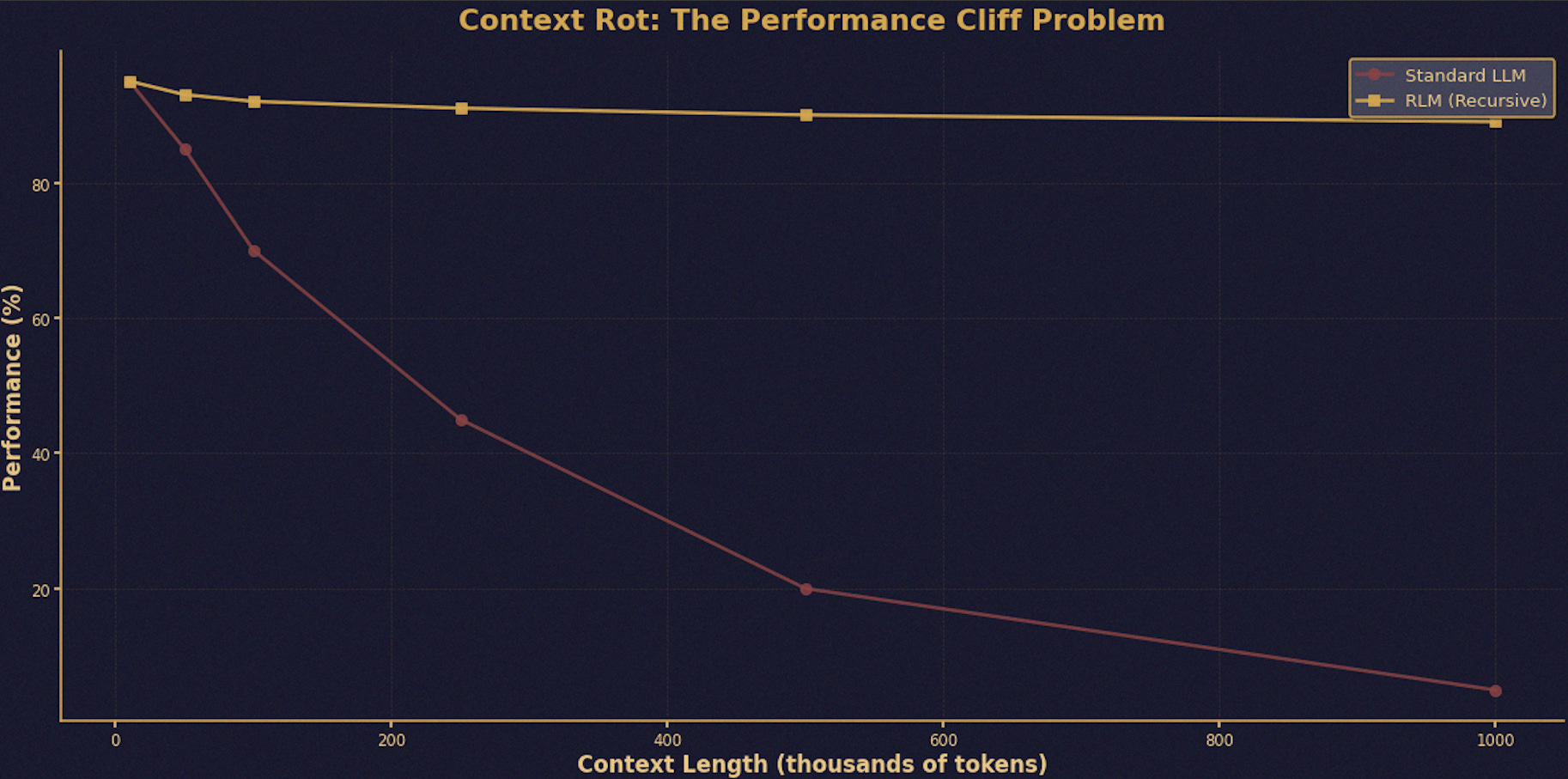
Zhang and his co-authors (Tim Kraska and Omar Khattab at MIT CSAIL) documented a phenomenon they call “context rot.” As you feed a model more text, its performance doesn’t just plateau it actively degrades. The model gets confused. It hallucinates connections. It forgets details buried in the middle of the prompt. More context, worse answers.
Think about what this means. We’ve been building bigger and bigger filing cabinets while the person looking through them gets progressively more overwhelmed.
The entire industry has been solving the wrong problem.
The 1,000-page book on your desk
Here’s where Zhang’s insight gets interesting and where a 50-year-old idea from classical computing enters the chat.
In the early days of computing, engineers faced a similar problem: datasets too large to fit in memory. Their solution wasn’t to build infinitely large RAM. They developed “out-of-core” algorithms methods that kept data on disk and pulled in only the pieces they needed, when they needed them.
RLMs apply the same logic to language models. And the analogy Zhang uses is perfect:
If someone handed you a 1,000-page book and asked you to analyze it, you wouldn’t try to memorize every word. You’d keep the book on your desk, flip to specific chapters, take notes, maybe ask a colleague to summarize a section. You’d interact with the text instead of trying to swallow it whole.
That’s exactly what an RLM does.
Here’s the mechanics. Instead of cramming the entire document into the model’s prompt, an RLM stores it as a variable literally P inside a Python coding environment (a REPL). The model then writes code to interact with that variable. It can search it, slice it, chunk it. And here’s the recursive part: it can spawn copies of itself to process individual chunks, then aggregate the results.
The model becomes a programmer managing its own reading process not a student cramming for a test.
The results that made me do a double-take
This isn’t a marginal improvement. The benchmarks are jarring.
On BrowseComp-Plus a brutally hard benchmark involving 6 to 11 million tokens of input standard GPT-5 scored 0%. The RLM-powered version scored 91.33%.
On OOLONG-Pairs, which requires quadratic-complexity reasoning (comparing pairs across thousands of entries), GPT-5 direct achieved an F1 of 0.04 essentially random noise. The RLM hit 58.00.
These aren’t incremental gains. The baseline completely fails while the RLM actually works.
And the cost? Roughly comparable to running the base model on shorter inputs. You’re not paying 100x more for 100x more context. You’re paying about the same because the model only reads what it needs to.
Small models, big upgrades
Here’s where it gets really exciting for anyone thinking about deployment costs.
Zhang’s team took Qwen3-8B a relatively small open-source model and post-trained it to be “natively recursive.” The result: a 28.3% performance boost across long-context tasks. An 8-billion-parameter model started approaching GPT-5-level performance on these benchmarks.
Let that sink in. You don’t need a trillion-parameter model to handle massive documents. You need a reasonably smart model that knows how to manage its own attention.
This is the “new axis of scale” the authors propose. Not bigger models. Not wider context windows. Smarter context management.
The three eras of AI scaling
The paper suggests a clean framework for thinking about where AI development is headed:
2024 was about scaling model size. More parameters, bigger training runs, higher compute budgets.
2025 was about scaling reasoning. Chain-of-thought prompting, reinforcement learning, test-time compute making models think harder rather than just knowing more.
2026 might be about scaling context management. Not by making context windows bigger, but by letting models decide what context they actually need.
If this framework holds, RLMs aren’t just a clever research trick. They’re the opening move in the next phase of AI capability.
What doesn’t work yet
Zhang and his team were refreshingly transparent about the limitations, and they matter.
Speed is a problem. The current implementation uses blocking calls the model pauses and waits for each sub-agent to finish before moving on. This makes it slow. Asynchronous execution would be a game-changer, but it’s not there yet.
The model needs to code well. Because RLMs rely on a Python environment, the underlying model must be genuinely good at writing code. Models that are strong at language but weak at programming will struggle.
Prompt fragility persists. A prompt that works perfectly for GPT-5 might cause Qwen3-Coder to launch thousands of recursive sub-agents simultaneously, crashing the system. Each model needs careful tuning.
Thinking tokens create bottlenecks. Models that generate internal reasoning traces sometimes run out of output space before they produce the actual code a frustrating failure mode unique to this paradigm.
These are real constraints. But they’re also engineering problems, not fundamental limitations. That’s an important distinction.
Why this matters more than you think
The implications cascade quickly once you start pulling the thread.
For builders: Every RAG pipeline, every document processing system, every AI agent that touches long-form content all of it could benefit from recursive self-calling. The team has released a minimal implementation on GitHub for anyone to build on.
For the industry: Google is already discussing RLM integration in their Agent Development Kit. Prime Intellect has declared RLMs a “major focus” of their research and called it “the paradigm of 2026.” This isn’t staying in academia.
For the trajectory of AI: If smaller models can match frontier model performance on long-context tasks simply by learning to manage their own reading the economics of AI shift dramatically. You don’t need the biggest model. You need the most strategically literate one.
We spent years making AI models that can hold more information in their heads at once. Zhang’s insight is that the smartest reader in the room isn’t the one with the best memory it’s the one who knows which pages to turn to.
2024 gave us bigger brains. 2025 gave us deeper thinking. 2026 might give us something more human: the wisdom to know what to pay attention to.
The book is on the desk. The model just learned to use the index.
References & Further Reading: